Research Portfolio

Remote Work, Meetings, and Human-AI Collaboration

Sean Rintel

A decade of research on embodied presence, intentional collaboration, and AI as a tool for thought

2015–2026

Three Threads of Research

This document traces three major research threads from 2015–2026, showing how ideas evolved, connected, and converged to address fundamental questions about remote work, intentional collaboration, and human–AI partnership.

Remote Equity & Presence tackles the challenge of giving remote workers genuine agency in shared spaces—from foundational video calling research through embodied avatars and telepresence. Meeting Intentionality & AI explores how to make meetings more focused and goal-aligned, extending across continuous work processes. AI & Cognition questions how AI systems shape human thinking, learning, and understanding.

Each thread represents a progression: from identifying problems through exploratory research, to controlled validation, to scaled deployment. Together, they form a connected research landscape where each thread informs and enables the others.

Remote Equity & Presence

As remote and hybrid work became prevalent, a fundamental inequality emerged: remote participants lacked the embodied presence of in-person attendees. This thread traces 10+ years of research from foundational video calling studies through embodied avatars and telepresence robots, exploring how technology can give remote workers genuine presence and agency in shared physical and digital spaces.

2015 • Early video-calling research
2015

Ad Hoc Adaptability in Video-Calling

Video calling research

Remote workers develop rich, improvised practices to manage framing, audio, and bandwidth—workarounds that become essential to participation.↳ Design for constraint, not just optimal conditions. Systems should support and surface user-developed adaptations rather than override them.

2016 • Mobile video messaging
2016

The Tyranny of the Everyday in Mobile Video Messaging

Mobile communication

Always-on video messaging creates an obligation economy: the expectation of constant availability blunts intimacy rather than deepening it.↳ Build in affordances for low-pressure, asynchronous presence. Don't default to real-time visibility as the measure of connection.

2019 • Hybrid meeting challenges
2019

Hybrid Meetings in the Modern Workplace: Stories of Success and Failure

Workplace research

Hybrid meetings fail not through technical problems but through norm failures—co-located participants unconsciously form cliques that exclude remote voices.↳ Make remote presence salient to in-room participants, not just to remote workers. Design for the room, not just the screen.

2020 • Meeting-centered design paradigm
2020

(Re)Configuring Hybrid Meetings: Moving from User-Centered Design to Meeting-Centered Design

Design research

User-centered design produces incompatible requirements when co-located and remote users have conflicting needs. Meeting-centered design finds better tradeoffs.↳ Optimize for meeting quality as the shared outcome. Individual user preferences must yield to the collective context.

2020 • Attention in remote meetings
2020

Classification of Functional Attention in Video Meetings

Attention research

Video meetings contain at least four distinct attention states—task focus, active listening, passive presence, multitasking—each producing different contribution patterns.↳ Design distinct affordances for each attention state rather than treating all engagement as equivalent or absence of visible engagement as disengagement.

2020 • Strategic remote participation
2020

Low Engagement As a Deliberate Practice of Remote Participants in Large Virtual Meetings

Meeting behavior

Low engagement in large virtual meetings is a deliberate, rational strategy for managing attention—not a failure of motivation or technology.↳ Design for optional, low-friction participation. Stop penalizing strategic disengagement; instead, create lightweight re-entry points.

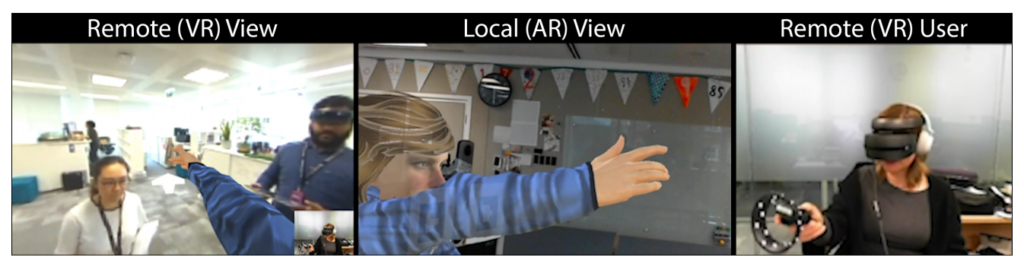
VROOM virtual robot overlay visualization
2020

VROOM: Virtual Robot Overlay for Online Meetings

CHI 2020

Virtual embodiments of remote participants—robot overlays in physical meeting rooms—improve spatial awareness, gaze direction, and turn-taking without requiring physical hardware.↳ Physicalize remote presence in the meeting room, not just on remote screens. Proxies that occupy space create measurable presence.

2022 • Social time in meetings
2022

Making Space for Social Time: Supporting Conversational Transitions in Video Meetings

Meeting design

Unstructured social interaction before and after formal agendas improves psychological safety and belonging—but it atrophies in hybrid contexts without explicit support.↳ Design explicit transitions into and out of agenda time. Social bonding requires affordance, not just permission.

2023 • Spatial audio in meetings
2023

Hear We Are: Spatial Audio Benefits Perceptions of Turn-Taking and Inclusivity in Hybrid Meetings

CSCW 2023

Spatializing audio—placing voices in 3D virtual space—measurably improves turn-taking equity and remote participants' sense of belonging without requiring cameras or visual tracking.↳ Invest in spatial audio as first-class infrastructure, not a premium add-on. Audio is a severely underused presence channel.

Perspectives on hybrid meetings
2023

Perspectives: Creating Inclusive and Equitable Hybrid Meeting Experiences

CSCW 2023

What inclusion means differs fundamentally across roles: organizers, remote attendees, co-located participants, and presenters each have distinct, sometimes conflicting needs.↳ Design role-specific tools and affordances, not single interfaces attempting to satisfy every participant equally.

Hybridge
2024

Hybridge: Bridging Spatiality for Inclusive and Equitable Hybrid Meetings

CHI 2024

Intentional spatial asymmetry—rather than forced equivalence between physical and digital spaces—gives remote participants genuine agency over shared environments.↳ Stop trying to make remote and in-room identical. Design distinct, complementary roles for each that leverage asymmetry as a feature.

VROOM uncanny valley
2021

Belonging There: VROOM-ing into the Uncanny Valley of XR Telepresence

CSCW 2021

Photorealistic telepresence triggers an uncanny valley effect; moderately stylized but clearly responsive avatars produce greater presence, trust, and social ease.↳ Don't chase photorealism. Invest in responsiveness and expressiveness. People connect to movement, not likeness.

2022 • Avatar aesthetics & interaction
2022

Nice Is Different Than Good: Longitudinal Communicative Effects of Avatar Appearance

Avatar research

Avatar appearance shapes communicative behavior: attractive avatars receive more engagement; aggressive avatars provoke different dynamics—and these effects persist over time.↳ Communicate appearance effects to users. Appearance customization is not cosmetic; it changes how others behave toward the person.

2024 • 3D video representation
2024

An Equal Seat at the Table: Exploring Videoconferencing with Shared Spatial Context

Spatial context study

When remote and in-room participants share a common 3D spatial reference frame—seeing each other in the same virtual room—turn-taking becomes more balanced and remote voices carry more weight.↳ Create shared reference frames, not just video tiles. Common spatial context redistributes conversational power more than better cameras alone.

2024 • Avatar animation realism
2024

Avatars in Mixed Reality Meetings: A Field Study of Avatar Facial Animation Realism

Avatar animation

In real MR meetings, moderate facial animation from webcam input outperforms both highly realistic rendering and static portraits on presence, communication quality, and comfort.↳ Target moderate animation fidelity and ship it. Moderate wins over both extremes; waiting for photorealism means waiting forever.

Nods of Agreement
2025

Nods of Agreement: Webcam-Driven Avatars Improve Meeting Outcomes

CHI 2025

Webcam-driven avatar animation—head nods, facial expressions—significantly improves objective meeting outcomes and participant satisfaction compared to audio-only or static avatars.↳ Ship webcam-driven avatars as the default. The gains are real and measurable; this should be table stakes, not a novelty feature.

Meeting Intentionality & AI

Meetings are plagued by unclear goals, misaligned expectations, and lack of focus. Can AI help make meeting intentions explicit, support goal-setting and reflection, and extend intentionality across continuous work processes—so decisions and learning from one meeting shape what happens in the next?

Mental models of meeting goals framework
2024

Mental Models of Meeting Goals: Supporting Intentionality in Meeting Technologies

CHI 2024

Workers hold two fundamentally different mental models of meeting goals—outcome-focused and process-focused—and current meeting tools serve neither well.↳ Design explicit, flexible goal-setting interfaces that accommodate both mental models rather than enforcing a single framework on all meeting types.

CoExplorer adaptive meeting interface
2024

The CoExplorer Technology Probe: A Generative AI-Powered Adaptive Interface

DIS 2024

An AI interface that recognizes meeting phases and proactively surfaces phase-appropriate tools—not all tools at once—reduces planning overhead and improves participant focus.↳ Design adaptive meeting systems that read context. The right tool at the right moment is more valuable than every tool always visible.

AI-assisted prospective reflection study
2025

What Does Success Look Like? Catalyzing Meeting Intentionality with AI-Assisted Prospective Reflection

CHIWORK 2025

AI-assisted pre-meeting reflection—prompting workers to articulate what success looks like—increases preparation quality, clarifies priorities, and surfaces hidden challenges before they derail a meeting.↳ Embed prospective intentionality into scheduling workflows, not just the meeting itself. Preparation is where most meeting failure is preventable.

Active vs. passive AI goal reflection comparison
2025

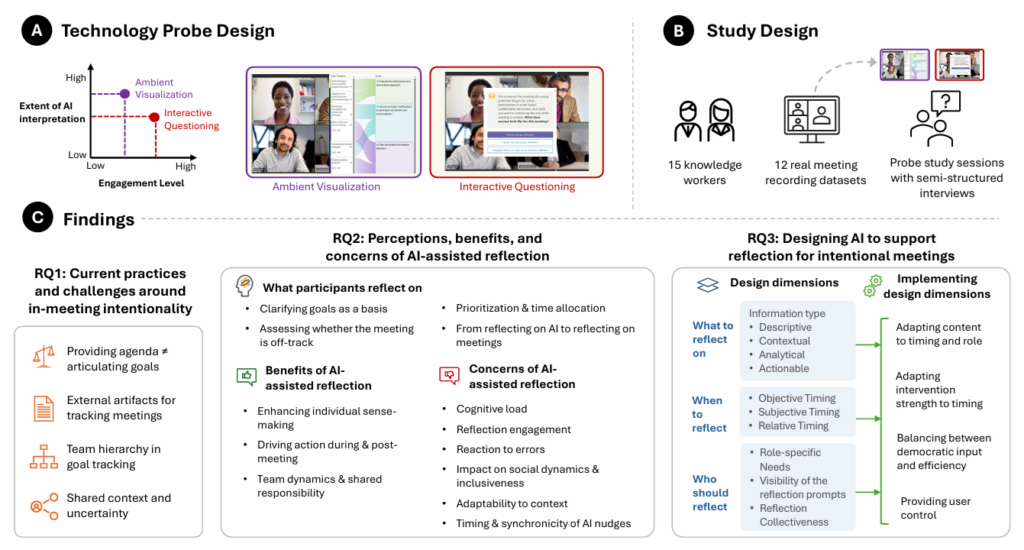
Are We On Track? AI-Assisted Active and Passive Goal Reflection During Meetings

CHI 2025

Passive AI goal signals—visible cues that don't interrupt—outperform active notifications for maintaining focus. Intrusiveness undermines the very intentionality it tries to support.↳ Design in-meeting goal cues as ambient signals, not alerts. Let participants choose when to attend to them rather than demanding their attention.

Large-scale preregistered field experiment overview
2026

Nudging Attention to Workplace Meeting Goals: A Large-Scale, Preregistered Field Experiment

CHI 2026

Goal-reflection nudges improve meeting effectiveness consistently across 7,196 meetings and diverse organizations. Effect sizes are modest but highly replicable—they compound at volume.↳ Don't wait for the perfect intervention. Lightweight goal-framing at scale outperforms elaborate single-meeting interventions. Scale is the multiplier.

Temporal work across meetings visualization
2025

Designing Interfaces that Support Temporal Work Across Meetings with Generative AI

DIS 2025

Meetings are nodes in a workflow, not isolated events. AI that chains decisions, goals, and learning across meeting sequences enables a continuous chain of intentionality across weeks of work.↳ Design for workflows, not moments. Build retrospective review and prospective planning into meeting tools as native features, not export functions.

AI & Cognition

Generative AI is reshaping how people work and think. But do AI systems actually enhance or undermine human cognition? How can AI systems be designed as tools for human thought rather than replacements for human judgment?

Metacognitive demands of generative AI
2024

The Metacognitive Demands and Opportunities of Generative AI

CHI 2024

Using generative AI creates invisible metacognitive labor—evaluating outputs, calibrating trust, iterating prompts—that accumulates as cognitive burden without being recognized as work.↳ Make the AI interaction loop visible. Show effort, surface uncertainty, and help users know when and how much to trust AI outputs.

2024 • AI productivity paradoxes
2024

Ironies of Generative AI: Understanding and Mitigating Productivity Loss in Human-AI Interaction

Conference paper

Productivity gains from AI tools are frequently offset by learning costs, error correction, trust evaluation, and managing others' expectations—the ironies that eat the benefit.↳ Measure net cognitive load, not speed. Design for sustainable productivity—tools that are trustworthy and correctable, not merely fast.

YES AND multi-agent ideation framework
2025

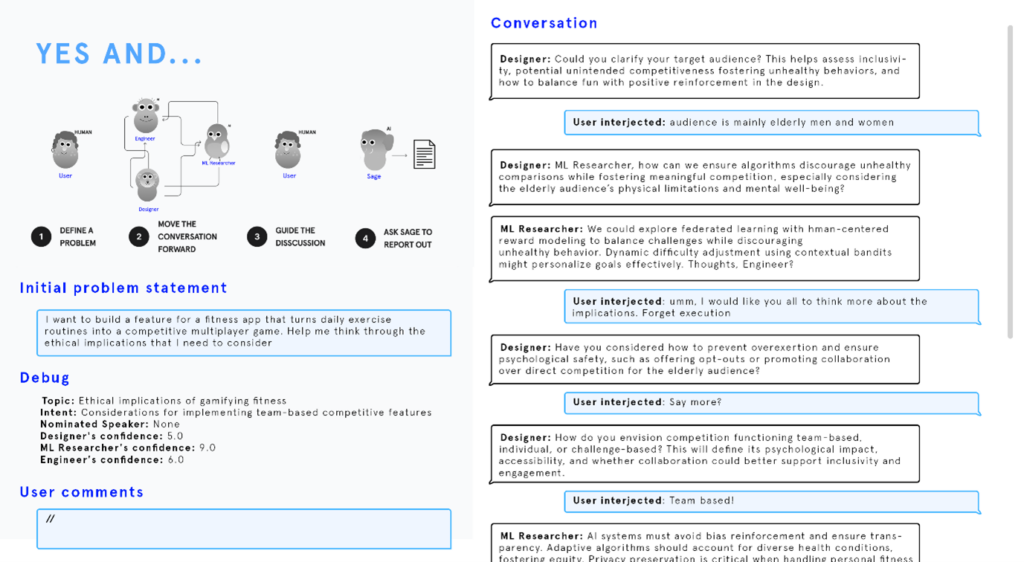
YES AND: A Generative AI Multi-Agent Framework for Enhancing Diversity of Thought

CHI 2025

A "yes-and" multi-agent structure—AI agents that build on ideas rather than evaluate or reject them—generates significantly more diverse, novel problem-solving than single-agent or standard brainstorming.↳ Design AI ideation systems as collaborative dialogue partners that expand the space of ideas, not judges that narrow it.

2025 • AI & cognitive engagement
2025

The Impact of Generative AI on Critical Thinking: Self-Reported Reductions in Cognitive Effort and Confidence

Knowledge workers survey

Among 1,000+ knowledge workers, heavier AI use correlates with reduced engagement in critical reasoning and lower confidence in one's own thinking—easy answers discourage reflection.↳ Build deliberate friction into AI workflows. Require users to evaluate, critique, or modify outputs—engagement with AI outputs should not be passive.

2025 • Interactive prompt refinement
2025

Dynamic Prompt Middleware: Contextual Prompt Refinement Controls for Comprehension Tasks

CHI 2025

When systems make prompt iteration visible and scaffolded, users engage in deeper reasoning about what they're asking and why—turning the prompt interface itself into a thinking tool.↳ Design prompt interfaces as structured thinking scaffolds, not just input boxes. Guide users through intent, not just syntax.

Student using LLM study setup
2025

Effects of LLM Use and Note-Taking On Reading Comprehension and Memory

Computers & Education 2025

LLM use alone reduces reading retention; paired with active note-taking, it improves higher-order synthesis. AI replaces the encoding that note-taking used to do.↳ Pair AI tools with active processing requirements. Don't let AI substitute for engagement—design it to require and reward annotation, summary, and critique.

2026 • AI as amplification not replacement
2026

Tools for Thought: Understanding, Protecting, and Augmenting Human Cognition with Generative AI

CHI 2026

AI amplifies human cognition only when systems keep reasoning visible, outputs are debuggable, and users can push back and refine iteratively. Opaque systems undermine the cognition they claim to support.↳ Treat transparency and correctability as core features. A tool that hides its reasoning cannot be a tool for thought.

Thread Convergence

The three threads increasingly intersect, showing how remote equity, intentional collaboration, and human-centered AI are deeply interconnected:

Remote Equity × Meeting Intentionality: Asymmetrical design makes sense in asymmetrical environments. Hybridge shows that intentional spatial asymmetry—rather than forcing false equivalence—actually enables remote participants genuine agency. One-size-fits-all solutions fail; tailored design for distinct roles succeeds.

Meeting Intentionality × AI & Cognition: Design for outcomes across workflows, not for singular tasks or moments. Papers like "Designing Interfaces that Support Temporal Work" show that both prospective intentionality (what do we want to accomplish?) and retrospective intentionality (what did we learn?) must be woven into continuous work processes. AI can bridge these when designed to support thinking, not replace it.

Research Synthesis: What We've Learned (2015–2026)

Over the past decade, three interconnected insights have emerged:

1. Remote presence is embodied, not just visual. Early video calling research revealed that presence requires more than a camera feed. Over 10+ years, we've shown that motion, spatial context, gaze, audio spatialization, and tangible interaction—not photorealism—create genuine presence. This matters because remote workers with genuine presence can participate fully in intentional collaboration.

2. Intentionality requires both explicit goals and continuous attention. Meetings fail not because people can't focus, but because goals are unclear and drift over time. AI can help make intentions explicit before and during meetings, and extend that clarity across multiple meetings as a continuous process. But AI interventions must be non-intrusive—supporting metacognitive awareness rather than replacing judgment.

3. AI is a cognitive tool, not a cognitive replacement. When AI systems help people think more clearly, work across diverse perspectives, and engage in deeper reflection, they amplify human agency. When they reduce cognitive engagement or replace judgment with convenience, they undermine it. The difference lies in system design: tools that make thinking visible and support metacognition vs. tools that hide thinking and simplify it away.

The frontier ahead: Integrated systems that combine all three: embodied presence (so remote workers have agency), explicit intentions (so collaboration is purposeful), and human-centered AI (so thinking stays visible and augmented, not replaced). The research that gets us there will require more interdisciplinary collaboration, more longitudinal validation, and more serious attention to how systems affect human cognition and equity.

Design Implications

1. Asymmetry is a feature, not a bug. Stop designing for false equity. Hybrid environments are fundamentally asymmetrical—some people are co-located, others remote. Design intentionally for those distinct contexts, with tools and affordances tailored to each role. Symmetry creates burden; asymmetrical design creates agency.

2. Design for the workflow, not the moment. Single-meeting focus fails. Build systems that maintain intention and learning across multiple meetings as a continuous process. Include both prospective intentionality (what are we trying to accomplish?) and retrospective intentionality (what did we learn?) as native features, not afterthoughts.

3. Make thinking visible. AI amplifies cognition only when systems reveal how outputs were generated, when users can push back on results, and when reasoning remains transparent. Hide the thinking, and you hide the harm. Visible thinking enables metacognition—the foundation of human agency with AI.

4. Motion and interaction matter more than realism. People connect to responsiveness and motion, not photorealism. Invest in systems that respond to subtle human behaviors—nods, gaze, gesture—rather than pursuing perfect likeness. Moderate animation beats perfect rendering.

Research portfolio curated by Sean Rintel, April 2026